Domino’s Pizza Slices & Calories — Complete Guide
Standard slice counts · Varies by cut style
Pick size, crust, and topping — results update instantly.
*Based on standard Domino’s US portion data. Actual values may vary slightly by location.
Domino’s Pizza Sizes, Slices & Calories — Key Facts
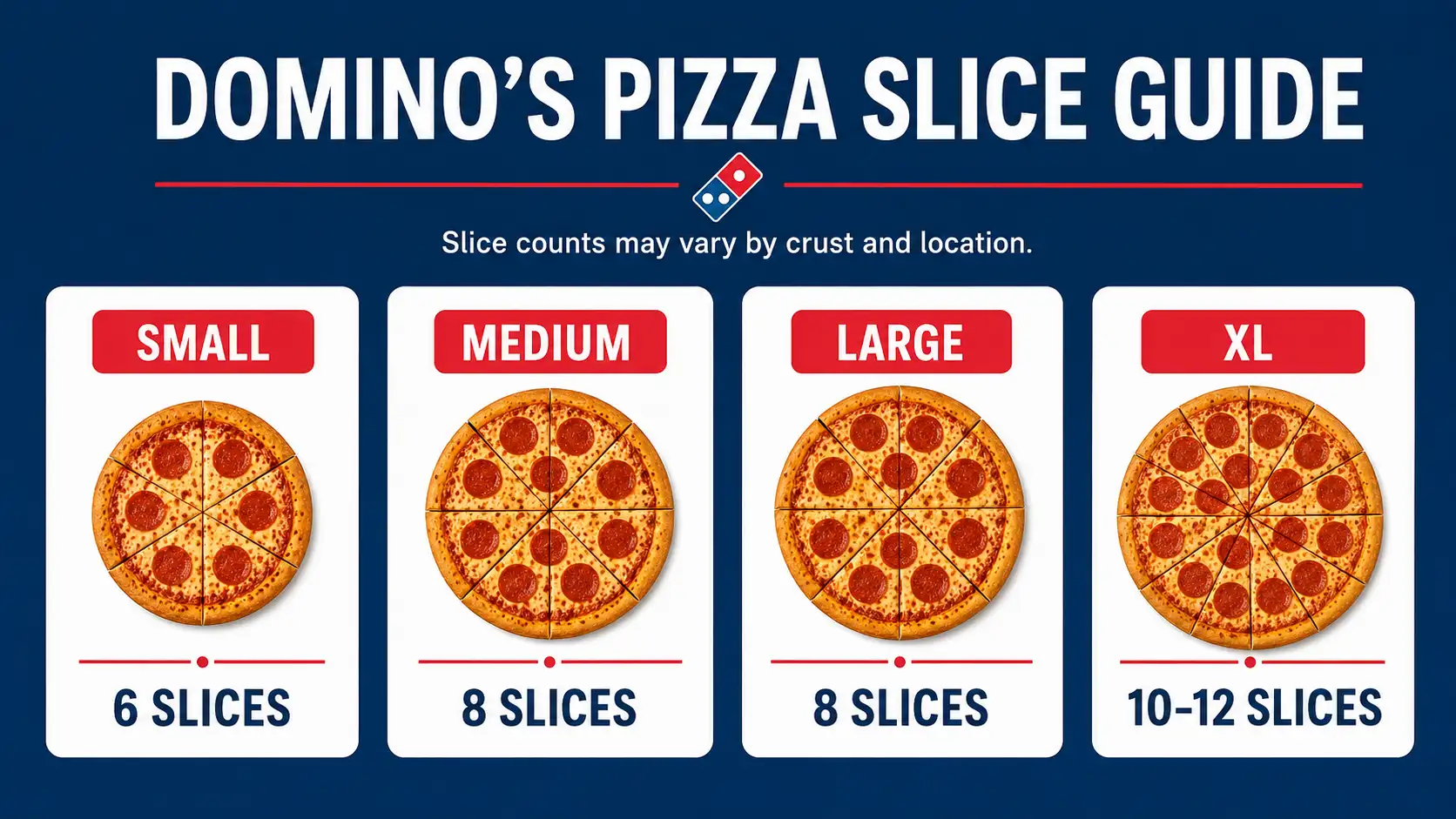
| Size | Diameter | Slices | Best For | Est. Calories (Cheese) |
|---|---|---|---|---|
| Small | 10 inches | 6 slices | 1–2 people | ~840 cal total |
| Medium | 12 inches | 8 slices | 2–3 people | ~1,600 cal total |
| Large | 14 inches | 8 slices | 3–4 people | ~2,000 cal total |
| XL (Brooklyn) | 16 inches | 6 slices | 4–5 people | ~2,400 cal total |
Note: A large pizza and a medium pizza both have 8 slices, but large slices are physically bigger — meaning more calories, more carbs, and more food per slice. Always account for size, not just slice count.
How Crust Type Changes Calories
The single biggest factor affecting Domino’s pizza calories is the crust. The same toppings on different crusts can swing calorie counts by 50–150 calories per slice. Here’s what you need to know:
| Crust | Med Cheese Cal | Med Carbs | Med Pepperoni Cal | Available Sizes |
|---|---|---|---|---|
| Thin Crust | 140 cal/slice | 11g | 165 cal/slice | M, L |
| Hand Tossed | 200 cal/slice | 25g | 240 cal/slice | S, M, L |
| Handmade Pan | 290 cal/slice | 30g | 330 cal/slice | M only |
| Brooklyn Style | 190 cal/slice | 20g | 230 cal/slice | L, XL |
| Gluten Free | 150 cal/slice | 22g | 175 cal/slice | S only |
Domino’s Pizza Calories — All Flavors & Sizes
The table below covers calories per slice for Domino’s most popular specialty pizzas and toppings on Hand Tossed crust — the most commonly ordered style.
| Topping / Specialty | Small/slice | Medium/slice | Large/slice | Whole Medium |
|---|---|---|---|---|
| Cheese Only | 140 cal | 200 cal | 250 cal | 1,600 cal |
| Pepperoni | 165 cal | 240 cal | 300 cal | 1,920 cal |
| Sausage | 175 cal | 250 cal | 310 cal | 2,000 cal |
| Beef | 170 cal | 245 cal | 305 cal | 1,960 cal |
| Ham | 150 cal | 215 cal | 265 cal | 1,720 cal |
| Mushroom | 145 cal | 205 cal | 255 cal | 1,640 cal |
| Pacific Veggie | 150 cal | 215 cal | 265 cal | 1,720 cal |
| Spinach & Feta | 165 cal | 250 cal | 310 cal | 2,000 cal |
| BBQ Chicken | 160 cal | 230 cal | 285 cal | 1,840 cal |
| Buffalo Chicken | 165 cal | 235 cal | 290 cal | 1,880 cal |
| Honolulu Hawaiian | 158 cal | 228 cal | 280 cal | 1,824 cal |
| ExtravaganZZa | 205 cal | 290 cal | 360 cal | 2,320 cal |
| MeatZZa | 220 cal | 320 cal | 390 cal | 2,560 cal |
*All values are estimates based on standard US Domino’s nutritional data. Actual calorie counts vary by preparation and location.

How Many Domino’s Pizzas Do You Need?
Use the industry-standard rule: 3 slices per adult, 2 slices per child. Adjust for appetite — hungry groups may need 4 slices per person.
| Guests | Slices Needed | Large Pizzas (8 sl.) | Medium Pizzas (8 sl.) |
|---|---|---|---|
| 2 Adults | 6 slices | 1 pizza | 1 pizza |
| 4 Adults | 12 slices | 2 pizzas | 2 pizzas |
| 6 Adults | 18 slices | 3 pizzas | 3 pizzas |
| 8 Adults | 24 slices | 3 pizzas | 3 pizzas |
| 10 Adults | 30 slices | 4 pizzas | 4 pizzas |
| 15 Adults | 45 slices | 6 pizzas | 6 pizzas |
| 20 Adults | 60 slices | 8 pizzas | 8 pizzas |
Domino’s vs Pizza Hut vs Papa John’s — Slices & Calories
Wondering how Domino’s stacks up against its competitors for slice count and calories? Here’s a direct comparison for a large (14″) hand-tossed cheese pizza:
| Brand | Large Size | Slices | Cal/Slice (Cheese) | Whole Pizza Cal | Carbs/Slice |
|---|---|---|---|---|---|
| Domino’s | 14 inch | 8 | 250 cal | 2,000 cal | 31g |
| Pizza Hut | 14 inch | 8 | 280 cal | 2,240 cal | 34g |
| Papa John’s | 14 inch | 8 | 270 cal | 2,160 cal | 32g |
| Little Caesars | 14 inch | 8 | 240 cal | 1,920 cal | 29g |
Among major chains, Domino’s Thin Crust is one of the lowest-calorie options at any pizza chain. For the standard hand-tossed, all four brands are comparable, with Domino’s being slightly leaner than Pizza Hut.
How Long to Burn Off a Slice of Domino’s Pizza?
One slice of a Domino’s medium pepperoni pizza (hand tossed) contains approximately 240 calories. Here’s how long different activities take to burn that off for an average 155 lb (70 kg) person:
Estimates based on a 155 lb / 70 kg person. Individual burn rates vary by weight, age, and intensity. Data source: MET value calculations (Compendium of Physical Activities).
Domino’s Pizza Terms Explained
- Hand Tossed CrustDomino’s signature crust, stretched by hand and baked with a garlic-oil seasoning on the edge. Available in Small, Medium, and Large. The “standard” crust for most nutritional comparisons.
- Thin CrustAlso called “Crunchy Thin Crust.” Thinner and crispier than hand tossed, with significantly fewer carbs (about 11g vs 25g per medium slice). Best choice for low-carb diets.
- Handmade PanDomino’s deep-dish option. The dough is pressed into an oiled pan, resulting in a thick, buttery crust. Available in Medium only. Highest calorie count of all crusts.
- Brooklyn StyleA large, thin, foldable crust inspired by New York-style pizza. Available in Large and XL. Cut into 6 extra-large slices rather than 8 standard slices.
- Gluten Free CrustAvailable for Small pizzas only. Made with rice flour. Domino’s notes it is prepared in shared facilities and is not suitable for people with celiac disease.
- ExtravaganZZaDomino’s most-loaded specialty pizza. Features pepperoni, ham, beef, sausage, mushrooms, onions, green peppers, and black olives. One of the highest-calorie specialty options.
- MeatZZaA meat-only specialty pizza featuring pepperoni, sausage, beef, and ham with extra cheese. Highest calorie count among Domino’s specialty pizzas.
Domino’s Slices & Calories — All Questions Answered
-
A Domino’s large pizza is 14 inches in diameter and is cut into 8 slices by default. This is consistent across all toppings — whether you order cheese, pepperoni, or a specialty like the ExtravaganZZa. If you order Brooklyn Style on a large, it is cut into 6 larger slices instead.
-
A Domino’s medium pizza (12 inches) contains 8 slices. The slices are smaller than those of a large pizza, but the count is the same. A medium is best for 2–3 people sharing a meal.
-
A Domino’s small pizza (10 inches) is cut into 6 slices. It is ideal for 1–2 people and is the only size on which Gluten Free crust is available.
-
The calorie count depends on size and crust. A medium hand-tossed pepperoni slice has approximately 240 calories. A large hand-tossed pepperoni slice has about 300 calories. A medium thin-crust pepperoni slice drops to roughly 165 calories. A whole medium pepperoni pizza (8 slices) contains approximately 1,920 calories.
-
A medium hand-tossed cheese pizza slice has approximately 200 calories. A large hand-tossed cheese slice has around 250 calories. A medium thin-crust cheese slice contains only about 140 calories — the lowest calorie option on the standard menu.
-
Carbohydrates are primarily determined by crust type. A medium Thin Crust slice has around 11g of carbs. A medium Hand Tossed slice has about 25g of carbs. A medium Handmade Pan slice has approximately 30g of carbs. Toppings add minimal carbs (typically 0–4g per slice).
-
Two slices of a medium hand-tossed cheese pizza = approximately 400 calories. Two slices of a medium pepperoni = approximately 480 calories. Two slices of a large pepperoni = approximately 600 calories. Two thin crust cheese slices = approximately 280 calories.
-
Yes. The lowest-calorie Domino’s pizza is a medium Thin Crust with vegetable toppings (mushroom, peppers, onions). A slice of medium thin-crust Pacific Veggie contains approximately 150 calories — comparable to many “health food” snacks. Avoid Pan crust and heavy meat toppings if minimizing calories.
-
For 10 adults, order 4 large Domino’s pizzas (32 total slices). This gives each person about 3 slices, which is the standard catering estimate. If guests have large appetites or you expect significant hunger, order 5 large pizzas to be safe.
-
Domino’s Gluten Free crust uses a certified gluten-free dough. However, Domino’s officially states that their kitchens are not gluten-free environments — cross-contact is possible during preparation. It is not recommended for people with celiac disease, but may be suitable for mild gluten sensitivities. Always consult your doctor if you have a medical gluten intolerance.